Behind the Visual Spectacle: Crafting 'The Mandalorian and Grogu'
ByMindy Kaling
In the highly anticipated film "The Mandalorian and Grogu," Industrial Light & Magic's animation supervisor, Hal Hickel, embraced a philosophy inspired by stop-motion pioneer Phil Tippett, integrating a blend of traditional and digital animation techniques. Hickel's approach sought to honor the legacy of "Star Wars" while pushing creative boundaries, resulting in a visual experience that captivated audiences. This deep dive into the film's production reveals the meticulous craft behind its iconic creatures and thrilling action sequences, highlighting the collaborative spirit and innovative methods employed by the visual effects team.
Hickel's journey with "The Mandalorian and Grogu" began with a fundamental question: "What would Phil (Tippett) do?" This ethos guided the team in combining digital animation with practical effects, mechanical rigs, and stop-motion. A notable aspect of the production involved Hickel's return to Tippett Studio's former Berkeley facility to personally animate a scene. This experience underscored the film's commitment to honoring the roots of "Star Wars" visual effects.
The film's opening AT-AT battle exemplifies this blend of old and new. Hickel revisited animation tests from "Rogue One," which involved integrating computer-generated walkers into original trilogy footage to analyze their lighting and texture. The colossal AT-ATs in "The Mandalorian and Grogu" were designed with an emphasis on weight and deliberate movement. An extensive interior set was constructed, extending into a movable head, though a planned gunfire exchange between characters on two walkers was eventually cut.
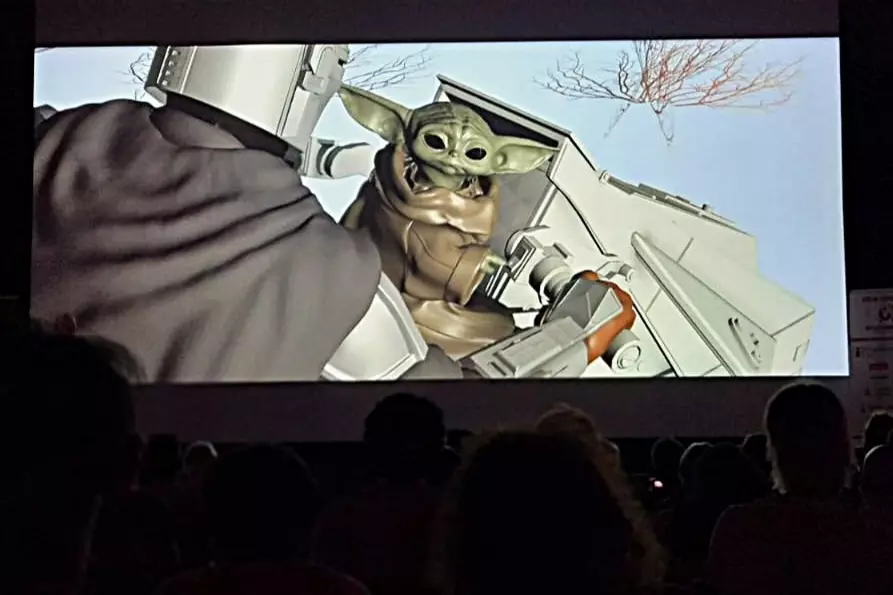
The smaller AT-RT vehicle presented its own set of challenges. Animators drew inspiration from ostriches to create digital movement curves, which were then translated into a six-axis mechanical rig for performers. Early tests were so intense that Hickel humorously remarked on the potential danger to Grogu. Director Jon Favreau's vision for Mando's action sequences leaned towards a "less James Bond, more Jackass" style, prioritizing perilous and often comedic escapes that kept audiences on the edge of their seats.
Rotta the Hutt, voiced by Jeremy Allen White, underwent a significant transformation from traditional Hutt depictions. Unlike Jabba's static presence, Rotta required a powerful, fighter-like movement while retaining a sympathetic quality. Legacy Effects provided full-sized physical models, and ILM developed a digital muscle system, drawing inspiration from elephant seals and sumo wrestlers. However, early designs reminded Favreau too much of "Battletoads," leading to revisions that brought Rotta's facial features and coloring closer to Jabba, while maintaining his muscular build. Hickel emphasized the goal of making Rotta a character audiences would root for, and revealed that Rotta had the second-highest amount of dialogue, prompting the decision to have him speak English for a younger audience. A touching homage to Hayao Miyazaki's "My Neighbor Totoro" was also included, with Grogu depicted sleeping on Rotta's chest, a moment confirmed by Hickel as a "Totoro" reference.
Another sequence brought the holographic chess monsters from the original 1977 "Star Wars" to life as full-sized combatants. Tippett and Jon Berg had originally created these miniatures under immense pressure. For the new film, ILM preserved their recognizable silhouettes while developing more realistic anatomy, movement, and fighting styles. Second-unit director Peter Ramsey collaborated with stunt performers, using surprisingly simple physical stand-ins for creature interactions, proving that "low tech" can sometimes be the most effective. The most direct tribute to Tippett's legacy came in a battle featuring two giant droids guarding an overlord's chamber. Hickel, working with Tippett's animators, transformed a few script sentences into a complex fight sequence. Tippett's team animated physical puppets, while ILM handled digital elements like fire, smoke, and explosions. Hickel even found himself animating a puppet frame by frame, an experience he described as a career highlight, especially given Tippett Studio's subsequent relocation.
The production of "The Mandalorian and Grogu" stands as a testament to the seamless integration of classic and contemporary visual effects techniques. Hal Hickel's dedication to honoring the past while embracing innovation, coupled with the collaborative efforts of a talented team, created a cinematic experience that resonated deeply with fans. From the redesign of beloved characters to the meticulous crafting of battle scenes, the film showcases a rich tapestry of artistry and technical prowess, ensuring its place as a significant contribution to the "Star Wars" universe.
About the author
Mindy Kaling
Actress, writer, producer, and author of humorous essays on Hollywood and life.