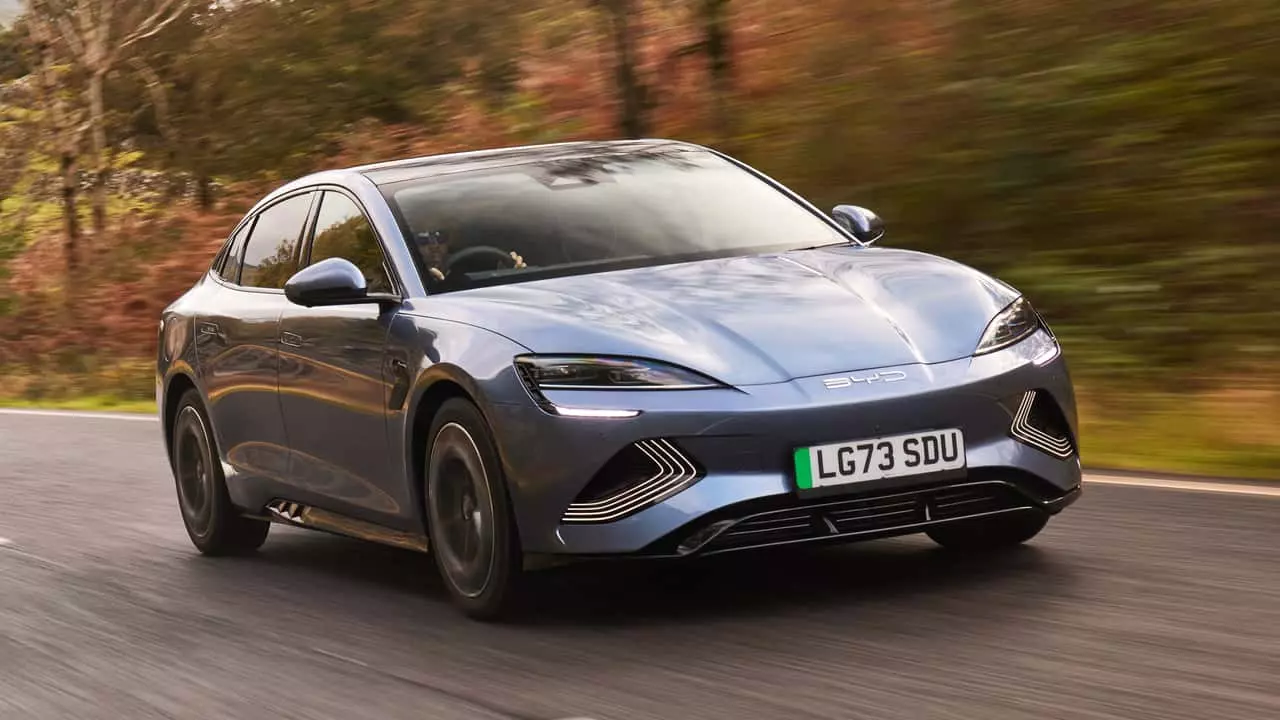
BYD's European Ascent Threatens Ford's Market Position
ByAkira Maruta
The European automotive market is currently witnessing a significant shift, with Chinese manufacturers rapidly ascending and challenging established players. This report delves into the recent performance of key Chinese brands, particularly BYD, and contrasts it with Ford's declining presence, highlighting the strategic divergence that is reshaping the competitive landscape.
A New Dawn in Europe's Auto Industry: Chinese Brands on the Rise
BYD's Remarkable Growth Trajectory
BYD, a Chinese automotive giant, has demonstrated an astonishing surge in vehicle registrations across Europe, recording a staggering 144.1% increase in the initial eight months of the current year. This impressive growth has propelled the company to a near-parity position with traditional automotive powerhouses, registering 234,099 units and closing the gap to just over 10,000 units behind Ford. This rapid expansion is a testament to BYD's aggressive market strategy and its commitment to broadening its vehicle portfolio in the region.
Ford's Shrinking Footprint in Europe
In stark contrast to BYD's upward trajectory, Ford has experienced a noticeable contraction in its European market share. The American automaker's registrations declined by 14.4% over the same period, reaching 244,938 units. This downturn is attributed to Ford's strategic decision to discontinue several popular models, including the Ka, Fiesta, Focus, and Mondeo, in favor of a more streamlined, albeit less diverse, product offering. The aging designs of remaining models like the Puma and Kuga further underscore the challenges Ford faces in maintaining its competitive edge.
Ford's Strategy for Reinvigoration
Acknowledging the intensifying competition, Ford is actively developing a counter-strategy to reclaim its market position in Europe. This involves a collaborative effort with Renault to develop a new range of electric vehicles. This partnership aims to leverage Renault's platforms for models that could potentially include a modern interpretation of the Fiesta, based on the Renault 5, and a compact crossover drawing inspiration from the Renault 4. Ford has committed to infusing these co-developed vehicles with distinct design elements and specific technical enhancements to differentiate them in the market.
The Broader Impact of Chinese Automakers
Beyond BYD, other Chinese automotive groups are also making substantial headway in Europe. SAIC, the parent company of MG, registered 230,290 vehicles, marking a 19.7% increase year-over-year and closely trailing Ford. Geely, encompassing brands such as Volvo, Polestar, and Lotus, has already surpassed Ford with 289,128 registrations, an 11.6% rise. Furthermore, Chery, with its Jaecoo, Jetour, and Omoda brands, recorded a phenomenal 279.7% increase, accumulating 207,871 registrations. Cumulatively, these four major Chinese groups now command a significant 10.4% share of the European automotive market, indicating a profound transformation of the industry landscape.
The Shifting Dynamics of the European Market
The remarkable rise of Chinese car manufacturers in Europe signifies a crucial turning point for the continent's automotive sector. What was once deemed improbable a decade ago is now an unfolding reality, as new entrants challenge long-established market leaders. This competitive pressure compels traditional automakers to reassess their strategies, focusing on innovation, product diversification, and responsive market engagement to contend with the dynamic landscape shaped by these rapidly growing Chinese brands.
About the author
Akira Maruta
Fictional representative of journalists deeply knowledgeable about JDM (Japanese Domestic Market) tuning and technology.