Dior's Evolving Legacy: Jonathan Anderson's Vision for Modern Femininity
ByTan France
After an initial period of adjustment, Jonathan Anderson, now 18 months into his leadership at Dior, is profoundly shaping his interpretation of the brand's storied legacy. He emphasizes the time required to elevate a brand, stating that it takes patience to assemble the right team and achieve the desired quality. Anderson noted a significant breakthrough in his recent work, where a collection rapidly materialized, signifying a clear vision and established framework. With his team firmly in place and a more complete understanding of the woman he designs for, he expressed a desire to embody her essence.
This dedication to and admiration for the female archetype he is cultivating was strikingly evident in the opening and closing ensembles. A delicate, double-breasted pinstripe blazer, layered over a silk striped button-up, was paired with a meticulously hand-cut butter yellow chiffon skirt, described by Anderson as comprising approximately twenty layers yet appearing as light as a mille-feuille. This signature look reappeared in the final presentation on model Mica Argañaraz, reimagined in navy pinstripe and glen check. Anderson highlighted the cyclical nature of these looks, allowing the wearer to transition seamlessly through various parts of her day.
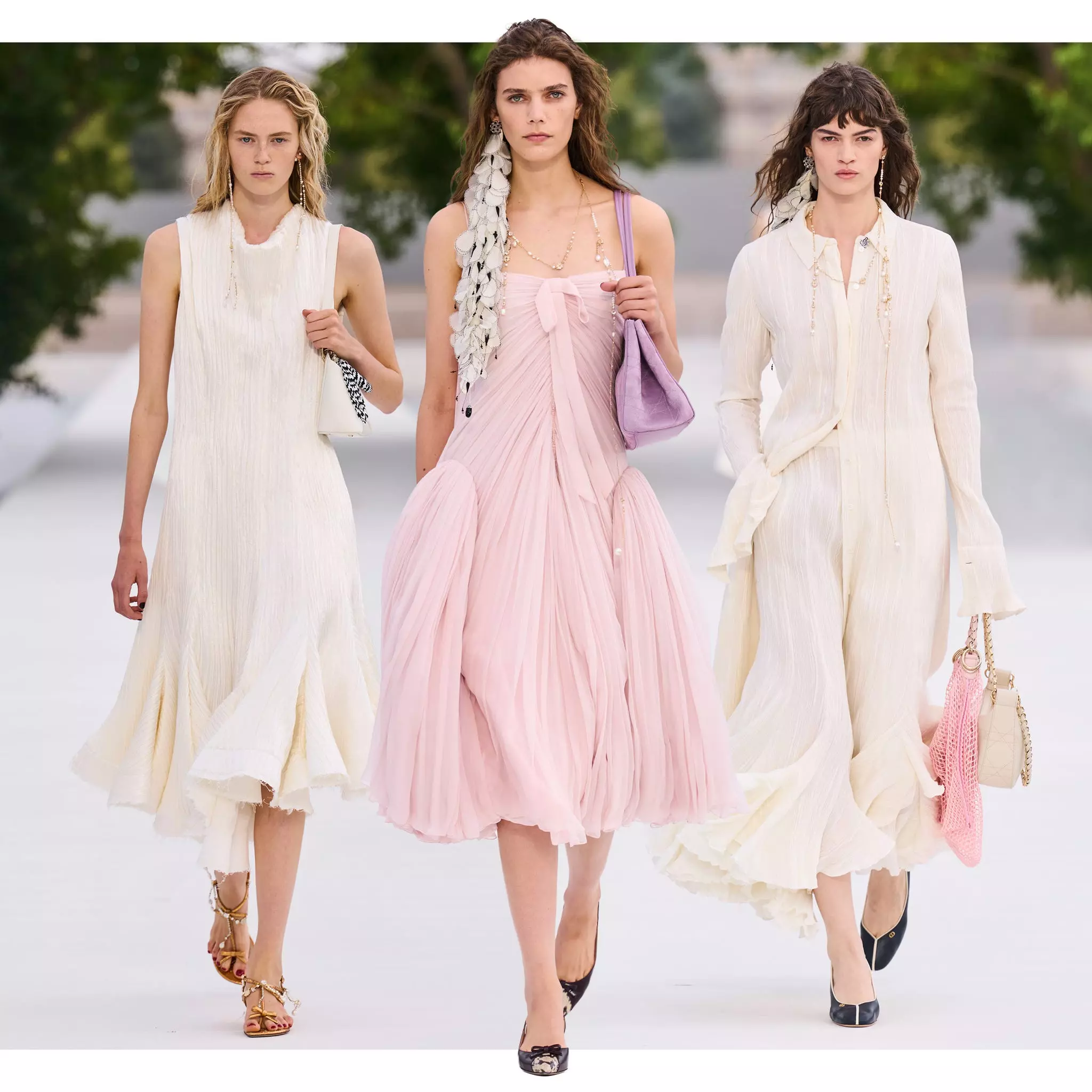
Dior's rich heritage, particularly the iconic Bar jackets and circular skirts introduced by Christian Dior in 1947, is deeply embedded in the brand's identity. Anderson's approach to translating these foundational ideas into the demands of modern life is by embracing lightness. He described a creative process involving the careful blending of hues, such as two yellows and an off-white, to create a family of ruffled, long-line dresses and coordinated jackets. Candied pinks adorned plissé skirts, while soft misty blues imbued raw silk mini-skirts with an ethereal quality, as if emerging from the misty pond at the show's center. The craftsmanship displayed was remarkably agile: three-dimensional petals, appearing as deconstructed floral elements, adorned cropped jackets, formed boas, and even served as earrings. While Christian Dior himself favored starched flowers, Anderson chose softer, more lifelike petals. Embroideries were skillfully employed to create the illusion of volume without adding bulk. Circular-cut dresses, though outwardly sweet and ample, featured robust internal construction, imbuing them with a sense of strength and authority.
Anderson conveyed his commitment to preserving the established codes of his predecessors, not abandoning them, but rather integrating and expanding upon the existing aesthetic language. Elements like zipped heels and deconstructed day bags bearing the D-I-O-R logo paid homage to the Galliano era. Furthermore, Anderson expressed reverence for a bag from Marc Bohan's tenure (1960s-1980s), which he reinterpreted. He focused on continuous improvement, posing questions such as, "How do we refine the material, enhance the zipper, and improve functionality?" This pursuit of ongoing resolution, development, and refinement underscores Anderson's strengths as a designer, consistently pushing the boundaries of innovation while respecting Dior's profound legacy.
About the author
Tan France
Fashion designer and TV host ("Queer Eye"), known for his classic style advice.