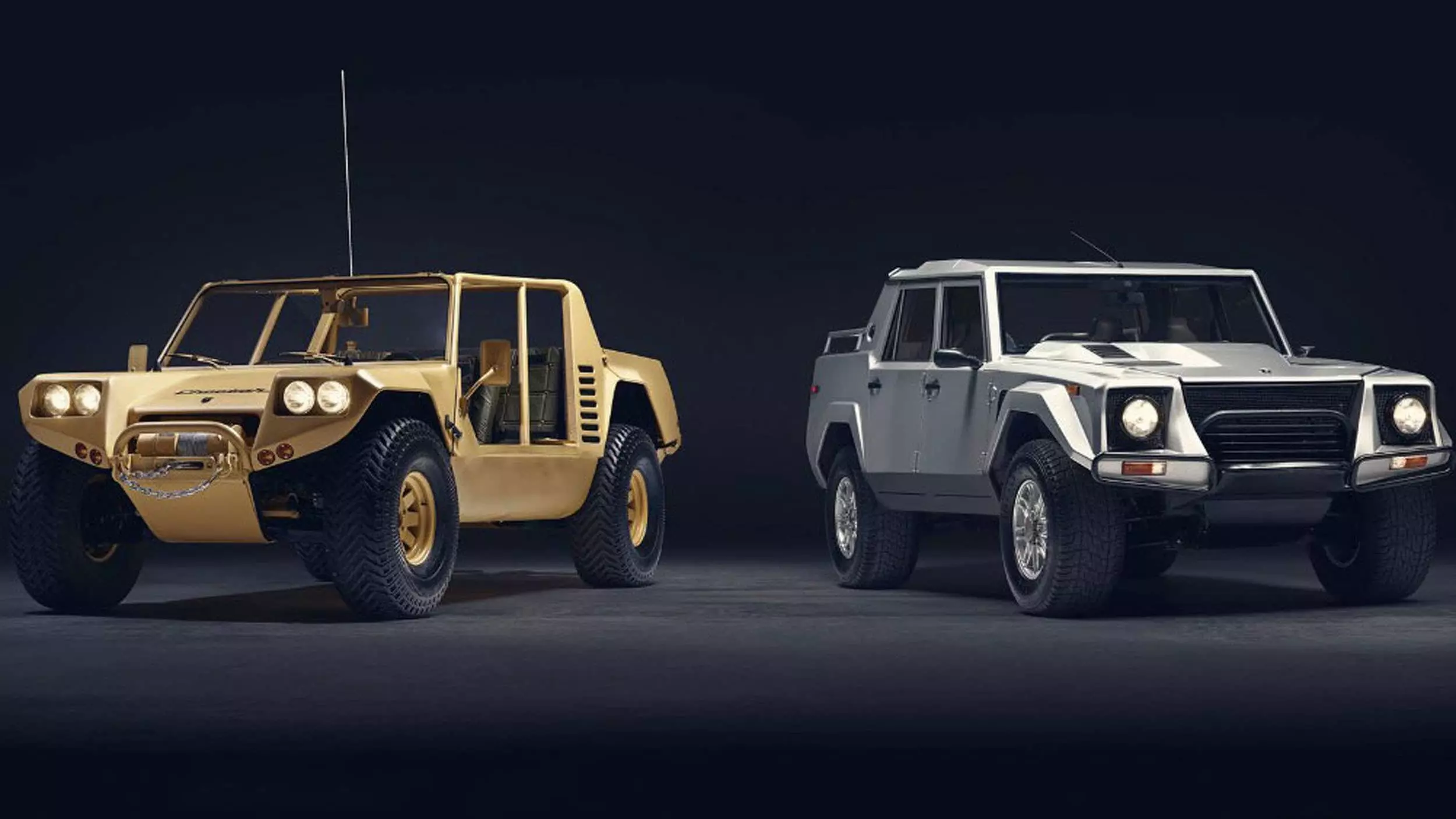
From Battlefield to Boulevard: The Genesis of Lamborghini's Legendary SUV
ByChris Harris
The Lamborghini LM002, an iconic and luxurious off-road vehicle, owes its existence to a surprising turn of events: a rejected proposal for a U.S. Army military contract. In the 1970s, as the American military sought a versatile replacement for its aging fleet of Jeeps and trucks, Lamborghini, facing financial difficulties, saw an opportunity. They developed the "Cheetah" prototype, an off-roader intended for both military and oil exploration use. Despite its initial ambition, the Cheetah proved unsuitable for the Army's needs, mainly due to its rear-mounted Chrysler V8 engine causing handling issues and insufficient power, leading the military to select what would become the Humvee instead. However, this military failure paved the way for Lamborghini to pivot the concept towards the luxury market.
Under new ownership, the "Militaria" project was revived, culminating in the LM002. This formidable vehicle, introduced in 1986, redefined the SUV landscape. It featured a front-mounted V12 engine from the legendary Countach supercar, bespoke Pirelli tires for extreme off-road performance, and a lavish interior complete with leather, power windows, and air conditioning. Marketed as a "desert luxury yacht," the LM002 was a stark contrast to the utilitarian military vehicles from which its lineage stemmed. Its rarity, outrageous performance, and celebrity ownership solidified its status as a highly sought-after collector's item and a precursor to Lamborghini's hugely successful modern SUV, the Urus, proving that even a rejected military project could birth an automotive legend.
The Unexpected Roots of Lamborghini's Off-Road Vision
Lamborghini's venture into the SUV segment began not with a market strategy for luxury vehicles, but with an ambitious, ultimately unsuccessful, attempt to secure a U.S. Army contract in the 1970s. During a period when the American military aimed to replace its aging fleet of utility vehicles, Lamborghini, a company known for its high-performance sports cars but rooted in agricultural machinery, saw an unconventional opportunity to diversify its revenue. This led to the development of the "Cheetah" prototype, an off-road vehicle designed to fulfill military requirements. The Cheetah aimed to transport soldiers across varied terrains, but its design, particularly its rear-mounted, underpowered Chrysler V8 engine, presented significant handling challenges and failed to impress military evaluators seeking a robust and easily maintainable solution. The Army eventually opted for the Humvee, leaving Lamborghini's military aspirations unfulfilled. This initial setback, however, inadvertently laid the foundational concept for a future, radically different product.
The mid-1970s marked a pivotal moment for both the U.S. military and Lamborghini. The military's existing fleet, primarily composed of aging Jeeps and other light trucks, was deemed insufficient for modern combat and logistical demands, prompting a search for a more capable and unified "High Mobility Multipurpose Wheeled Vehicle" (HMMWV). Simultaneously, Lamborghini faced financial strains, seeking new markets beyond its niche supercar production. Leveraging its founder Ferruccio Lamborghini's background in tractor manufacturing, the company embarked on the "Cheetah" project in collaboration with Mobility Technology International (MTI). This prototype was envisioned as a versatile off-roader for military applications and lucrative oil exploration contracts. The Cheetah featured a fiberglass body and was designed to carry four equipped soldiers, powered by a 5.9-liter Chrysler V8. Critically, the engine's rear placement resulted in poor weight distribution and handling difficulties, while its 180 horsepower was deemed inadequate for the vehicle's 4,500-pound weight and the demanding military specifications. The Army prioritized simplicity, ruggedness, and ease of maintenance, qualities the experimental Italian prototype could not fully deliver. This rejection, while a blow to Lamborghini's military ambitions, serendipitously set the stage for its iconic luxury SUV, compelling the company to reimagining the vehicle for an entirely different audience.
From Military Rejection to Luxury Icon: The LM002's Legacy
Despite the U.S. Army's rejection of the "Cheetah" prototype, Lamborghini's vision for a high-performance off-road vehicle did not end. After a change in ownership, the concept was revitalized and reoriented from military utility to extreme luxury. This led to the creation of the LM002, unveiled in 1986, a vehicle that dramatically contrasted with its military predecessors. Engineers redesigned the chassis, relocating the engine to the front and integrating the powerful V12 from the Countach supercar, transforming the vehicle's performance and handling characteristics. The LM002 quickly earned the moniker "Rambo Lambo" due to its imposing, rugged exterior combined with exhilarating speed. It offered an unparalleled blend of formidable off-road capability and opulent cabin amenities, setting a new standard for extravagant utility vehicles. This transition from a failed military project to a high-end consumer product showcased Lamborghini's adaptability and laid the foundation for its enduring legacy in the SUV market.
Following the military's decision to pursue the Humvee, the French-Swiss Mimran brothers acquired Lamborghini around 1980-1981, recognizing the untapped potential in the off-road concept, especially for affluent markets in the Middle East. They commissioned an evolution of the Cheetah, initially showcasing the LM001 prototype. Addressing the critical handling flaws of its predecessor, designer Giulio Alfieri spearheaded a complete overhaul, developing a robust tubular steel frame that allowed for a front-engine layout. This crucial design change enabled the integration of the celebrated 5.2-liter Countach V12 engine, initially producing around 450 horsepower, with options for even larger powerboat racing engines. The resulting LM002 was a colossal machine, weighing approximately 2.7 tons, measuring nearly 190 inches long, and featuring bespoke Pirelli Scorpion tires specifically designed for its unique demands. It boasted a top speed of 130 mph, a remarkable figure for a vehicle with such a commanding presence and brick-like aerodynamics. Inside, the LM002 was a sanctuary of luxury, equipped with premium leather seating, power windows, and air conditioning, making it a "desert luxury yacht" rather than a utilitarian truck. Produced from 1986 to 1993, with only about 328 units made, its exclusivity, extreme capabilities, and celebrity appeal established it as a legendary collector's item and cemented Lamborghini's unforeseen but significant heritage in the SUV segment, directly influencing the eventual success of the Urus.
About the author
Chris Harris
Driver and journalist, now with Top Gear, renowned for his technically skilled and enthusiastic car reviews.