Remedy Entertainment's 2019 title, Control, a paranormal third-person shooter, left a lasting impression on many players, primarily due to its intricate backstory. The game's setting, The Oldest House, an imposing Brutalist building in Manhattan, was filled with redacted documents that either revealed or obscured the workings of the Federal Bureau of Control. This distinctive narrative approach was so impactful that it became synonymous with the game, making blacked-out text instantly recall Control for its fans.
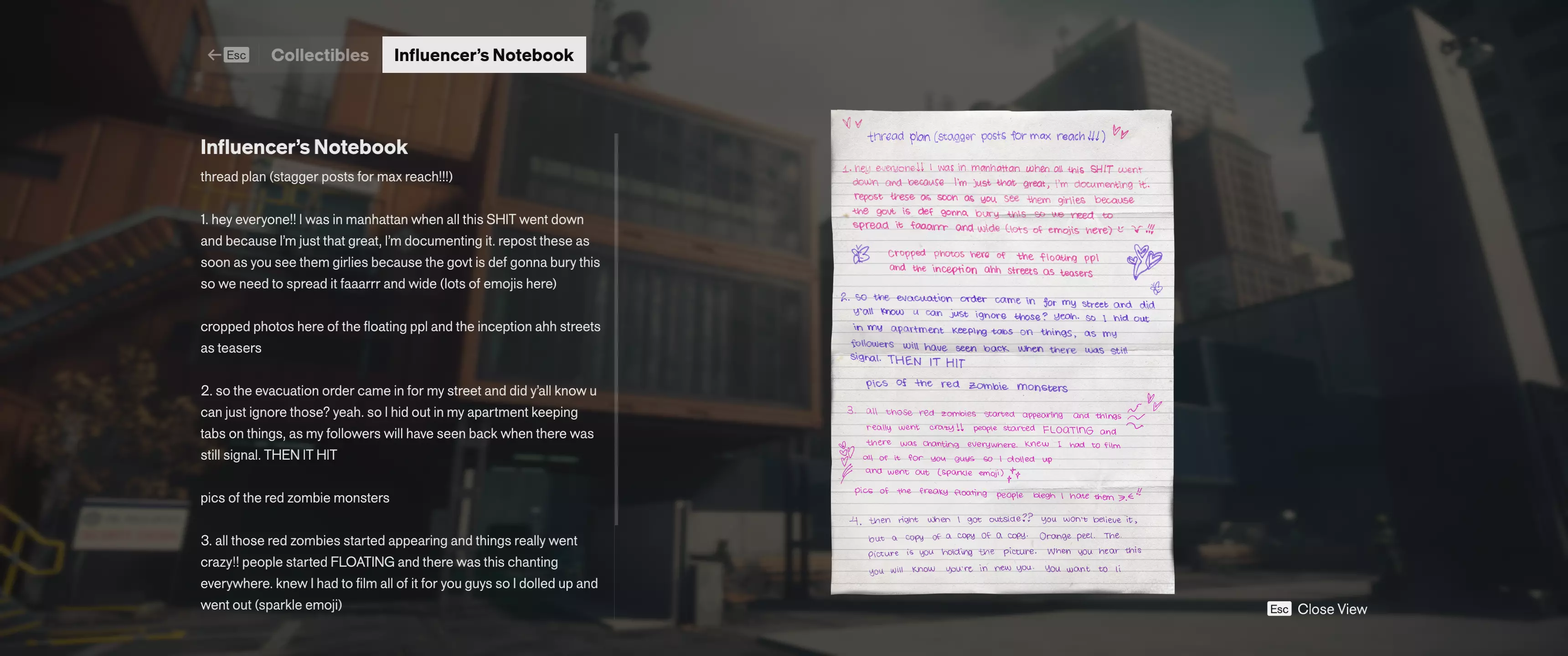
Building on this foundation, Remedy aimed to enhance its storytelling for Control Resonant. Even though the sequel moves the action from The Oldest House to the Hiss-ridden streets of Manhattan, protagonist Dylan Faden continues to discover numerous notes and audio logs detailing an apocalyptic event. While the rich narrative is intended as a highlight of Resonant, it inadvertently creates a minor problem: the overwhelming abundance of lore for players to sort through.
Despite this, the caliber of Remedy's writing remains exceptional; each piece of lore encountered in Resonant is meticulously crafted. Even a simple tuning fork puzzle in the subway is elevated by accompanying notes that vividly portray a research team's frustration with inexplicable teleportation. This thoughtful integration ensures that every element of Resonant's world feels narratively driven rather than merely serving gameplay mechanics, setting Remedy apart as a premier developer in the industry.
The primary issue lies in the distribution of these narrative elements. Initially, lore entries appear at a manageable rate, offering brief pauses for reading to establish the scene. However, as players progress, the volume of these logs escalates rapidly, becoming overwhelming. For instance, in a mid-game mission within a subterranean maze, Dylan encounters numerous FBC test sites in a liminal space, each brimming with text and audio logs that appear almost consecutively. This constant interruption forces players to repeatedly halt their progress to engage with the narrative content.
Audio logs in Resonant present a unique challenge. While they autoplay upon collection, theoretically allowing players to listen while continuing gameplay, they abruptly cease if any story-related dialogue is triggered. Given the game's heavy reliance on dialogue, these triggers often occur close to where logs are found, forcing players to enter the menu and restart playback. Consequently, players often find themselves standing still to ensure an audio log finishes uninterrupted, disrupting the flow of the game.
Ultimately, these issues are not critical flaws but rather minor annoyances, especially since all lore is optional and can be accessed at leisure. Nevertheless, it highlights Resonant's reliance on exposition rather than immersive storytelling, hindering the pacing of a game designed for dynamic movement and action. Moreover, the sheer volume of logs feels less cohesive than in the original Control. The first game, set in a government agency's office, naturally explained the presence of scattered paperwork as indicative of the FBC's lax security. In contrast, Resonant focuses more on the relationship between Jesse and Dylan, making the profusion of documents feel like a distraction from the game's core emotional narrative.
This overflow of lore is not unique to Remedy; it's a prevalent design trend in various games, from compact titles like Pragmata to sprawling open-world epics such as The Blood of Dawnwalker. When used sparingly, lore can enrich a world, making it feel more vibrant and lived-in, as exemplified by the Resident Evil series. However, when overused, it can disrupt the momentum of action-oriented games like Marvel’s Wolverine, where players are forced to repeatedly pause to listen to audio logs, an unengaging way to deliver a story.
Instead of advocating for less world-building, a more integrated approach to storytelling within gameplay would be beneficial. Environmental design, for instance, allows players to infer narratives without explicit exposition. Much like the real Manhattan, which inspires Resonant's setting, encountering subtle clues and unsolved mysteries can leave a lasting, intriguing impression. Sometimes, less direct explanation allows for a more profound and memorable experience.
About the author
Shigeru Miyamoto
Legendary game designer at Nintendo, creator of Mario, Zelda, and Donkey Kong.