Understanding Gary Larson's Timeless Humor in 'The Far Side' Through Its Musical References
ByRoberta Williams
Gary Larson's 'The Far Side' stands as a monument of comedic artistry, beloved for its ability to blend the surreal with the relatable. While many of its themes—like cows, cave dwellers, and ancient beasts—transcend time, a unique subset of Larson's work is deeply embedded in the musical landscape of its era. These particular strips offer a fascinating glimpse into the cultural zeitgeist of the 1980s and 1990s, requiring a deeper understanding of period-specific allusions to fully appreciate their genius. This piece unpacks some of these time-bound musical jests, revealing the witty commentary Larson embedded within his seemingly simple panels.
Unraveling the Enduring Laughter: Larson's Musical Wit Explained
The Iconic Pop Star and Her Bold Fashion Statement
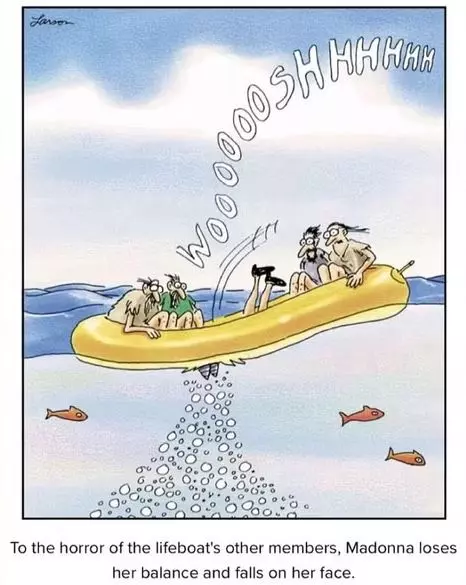
Even today, Madonna remains a significant figure in music, but her colossal fame in 1992, when Gary Larson penned a particular strip, was unparalleled. This comic playfully critiques her famous cone bra, first seen during her 1990 "Blond Ambition" tour. Designed as a symbol of female empowerment and a jab at traditional norms, Larson's comic cleverly reimagines this avant-garde attire as impractical for a life raft, highlighting his knack for finding humor in cultural phenomena.
The Darkly Humorous Tune of a Bygone Era
One surreal 'Far Side' panel references "Mack the Knife," a song from the 1928 musical 'The Threepenny Opera.' Despite its grim subject matter—a serial killer—the tune gained widespread popularity, with notable renditions by jazz legends Louis Armstrong and Ella Fitzgerald, and a definitive rock and roll version by Bobby Darin in 1959. Larson's use of this song, even in 1987, already played on its dated appeal, showcasing his awareness of music's historical context.
A Playful Twist on a Classic Ballad
Larson's subtle humor shines in a comic centered around "Blueberry Hill," a 1940 song that achieved massive success in the 1950s through artists like Elvis Presley and Fats Domino. The joke hinges on knowing the opening lyric, "I found my thrill on Blueberry Hill." Larson ingeniously substitutes "thrill" with "drill," creating a comical scenario about a man's misplaced power tool, a testament to his clever wordplay.
Nonsense Lyrics and Amphibian Antics
Another comic strip draws its humor from the lyrics of Three Dog Night's 1971 hit, "Joy to the World." The song's memorable, often whimsical opening verse, "Jeremiah was a bullfrog / Was a good friend of mine / I never understood a single word he said / But I helped him a-drink his wine / And he always had some mighty fine wine," is brought to life by Larson. He depicts bullfrogs indulging in "mighty fine wine," literally translating the song's playful absurdity into a visual gag.
Dancing Reptiles and Rock 'n' Roll Echoes
Larson again utilizes a popular rock song to inspire animal-themed comedy. "Let's Twist Again," Chubby Checker's 1961 follow-up to "The Twist," inspired a strip featuring a snake singing the song's exact lyrics. A delightful detail is Larson's inclusion of Checker's iconic hair and bow tie on the singing snake, adding an extra layer of recognition for those familiar with the artist and the dance craze.
Musical Mismatches and Avoidable Albums
A 1992 comic, framed as "Albums to avoid," features a series of mini-jokes that satirize various artists and hypothetical musical collaborations. One notable example pokes fun at the idea of a duet between the legendary crooner Frank Sinatra and pop icon Prince, suggesting an unlikely and perhaps disastrous musical pairing. This comic highlights Larson's keen observation of musical genres and artist personas.
The Enduring Legacy of a Cinematic Classic
This particular comic playfully references Steven Spielberg's 1975 blockbuster, 'Jaws.' The humor here relies on the film's enduring status as a cultural touchstone. Had 'Jaws' not remained one of cinema's most iconic and recognizable movies, the joke might have faded into obscurity, underscoring how some pop culture references, unlike others, manage to withstand the test of time.
About the author
Roberta Williams
Pioneer of graphic adventure games, co-founder of Sierra On-Line, and creator of "King's Quest."