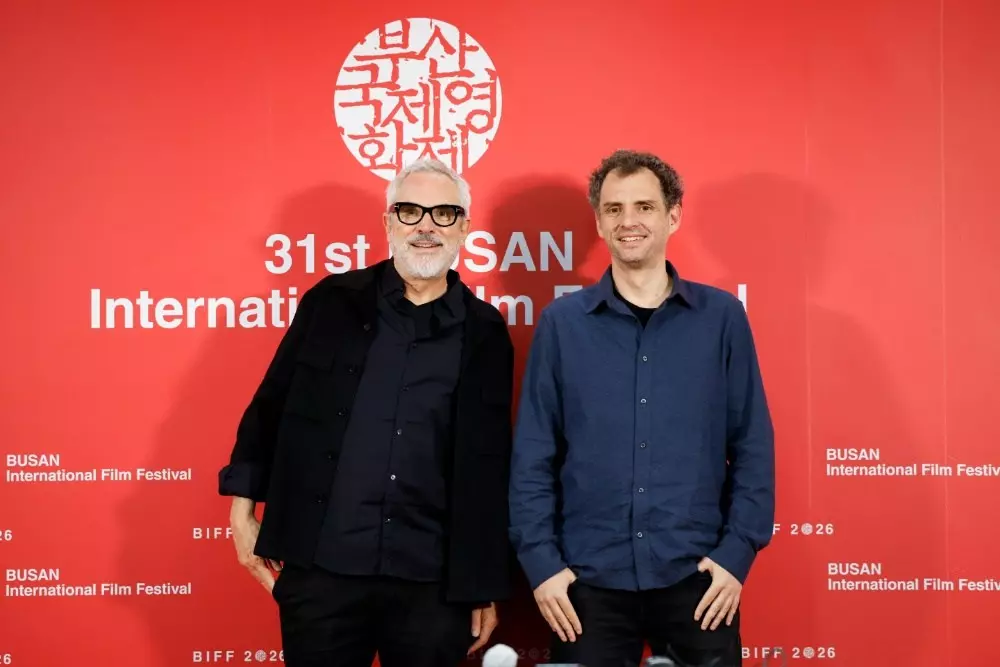
Alfonso Cuaron and Son Jonas Reflect on 'Gravity' and Evolving Perspectives at Busan Film Festival
ByRicky Gervais
Alfonso Cuarón, the celebrated Oscar-winning director, recently articulated a profound evolution in his creative philosophy, stating that his focus has shifted from solely prioritizing filmmaking to embracing life's broader experiences. This reflection took place at the Busan International Film Festival, where he and his son, Jonas Cuarón, discussed their collaborative work on the critically acclaimed 2013 space survival drama, 'Gravity.' Their insights offered a glimpse into the personal and professional dynamics that shaped one of modern cinema's most impactful films, highlighting a shared dedication to powerful storytelling and innovative cinematic techniques.
Filmmaking Visionaries Unpack 'Gravity's' Genesis and Enduring Impact at Busan
On October 8, 2026, at the esteemed Busan International Film Festival, Oscar-winning director Alfonso Cuarón and his son, Jonas Cuarón, captivated an audience with a masterclass session dedicated to their groundbreaking film, 'Gravity.' The previous day had seen a special IMAX screening of the movie, offering a fresh perspective on its immersive narrative. Alfonso, known for his masterful direction, candidly shared how his perspective on life and art has transformed over the years. He explained that in his youth, cinema was his sole obsession, with life merely serving as a backdrop. Now, his priorities have reversed; he values life as an experience above all else, believing it enriches his artistic endeavors. This shift underlines a matured approach to his craft, where personal depth informs professional expression.
Jonas Cuarón, who co-wrote 'Gravity' and also premiered his film 'Campeón Gabacho' in the World Cinema section at Busan, echoed his father's sentiments on the power of cinema. He emphasized that 'Gravity's' core narrative revolved around themes of rebirth, resilience in the face of adversity, and the profound human desire to survive. The father-son duo's collaboration on 'Gravity' was a confluence of their shared passion for cinema and a meticulous dedication to technical innovation. Alfonso recalled how they meticulously planned the film's extended takes and camera movements to immerse the audience emotionally, drawing inspiration from the likes of Alfred Hitchcock's method of placing ordinary individuals in extraordinary circumstances.
The production of 'Gravity' pushed technological boundaries, employing a custom-designed LED lightbox system to dynamically simulate space environments on the actors, complemented by robot-controlled cameras and extensive computer-generated imagery. This innovative approach allowed them to achieve an unprecedented level of realism and emotional intensity. Alfonso further elaborated on his directorial philosophy, quoting French filmmaker Alain Resnais' belief that among a myriad of camera placements, only one is truly right. This principle underscores his emphasis on intentional framing, where what is left unseen is often as crucial as what is visible, a perspective he believes distinguishes cinema from virtual reality. Jonas, for his part, expressed a keen admiration for the narrative richness and distinctive humor found in Korean genre films, citing works such as 'The Host,' 'Parasite,' and 'Train to Busan,' the latter of which held a special significance for his family due to his young son's enthusiasm.
Looking ahead, Jonas is concentrating on his recently completed project while exploring new avenues for films in development. Alfonso, ever the visionary, expressed an interest in venturing into comedy and learning from the fresh perspectives of younger filmmakers, underscoring his belief in the enduring power of audience connection and his identity as a devoted cinephile.
The Cuaróns' discussion at Busan serves as a potent reminder that filmmaking is not merely a technical exercise but a deeply personal journey. Their emphasis on life's experiences enriching art, coupled with their relentless pursuit of cinematic innovation, inspires creators to delve beyond the surface and craft stories that resonate universally. It reinforces the idea that true artistry springs from a well of lived experience and an unwavering passion for the medium, constantly pushing boundaries while staying true to the human element.
About the author
Ricky Gervais
Comedian, writer, and actor who created "The Office" and writes provocatively on comedy and society.